Jim Jarmusch in the Age of Algorithmic Overload
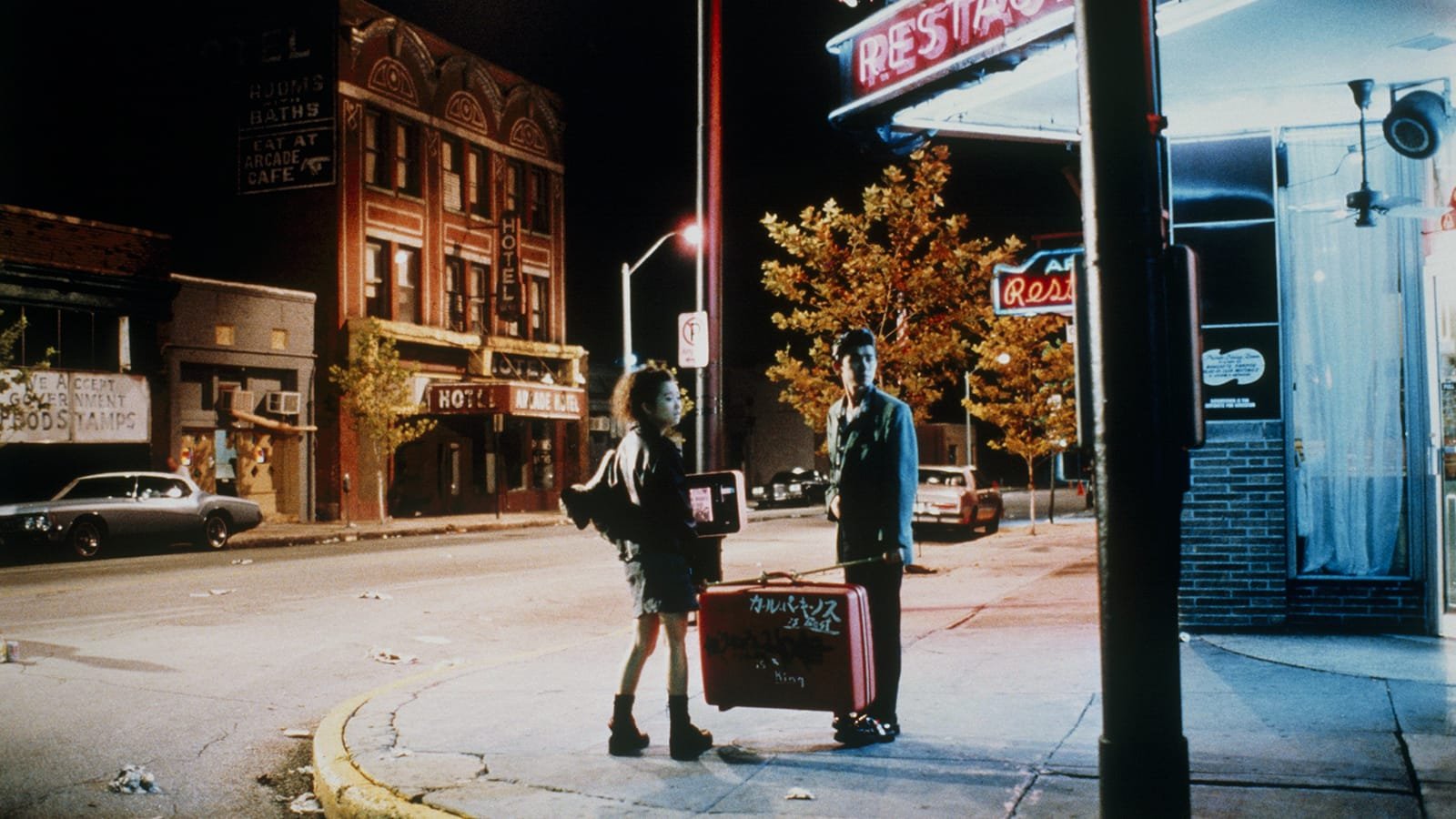
In a culture of endless scrolling, Jim Jarmusch’s Mystery Train offers an antidote through its triptych of drifters passing through a Memphis motel over the course of a single sleepy night.
Young people today are exhausted by a pervasive overload of stimulation, as the unrelenting glare of our phone screens bores into our eyeballs. The modern attention economy makes it increasingly difficult to inhabit the present moment, inducing a state of ‘choice fatigue’. Even for the cool, micro-fringed, vogue-smoking contrarians I meet at university, who choose to wield a flip phone in protest against this algorithmic exhaustion, it nevertheless feels inescapable. Beyond our devices, speed has become the organising principle of everyday life. No effort is required to fill time, no waiting for solutions to arrive; everything is immediately available, an excess of information that deadens the nerves.
With the success of the recent release of Father Mother Sister Brother, the films of Jim Jarmusch are proving to be increasingly appealing for young audiences as an antidote to the global economy of speed. Like much of his work, the film follows an anthology structure, and unfolds through a series of loosely connected stories. Jarmusch is often associated with so-called 'slow cinema’, that is, contemporary art films defined by long takes and understated narrative structures. In interviews, Jarmusch has described his interest in “little incidental things” and the interstitial moments that conventional Hollywood storytelling tends to excise in favour of plot and forward motion. Father Mother Sister Brother had a lasting effect on me, drawing attention to idiosyncrasies of family relationships that occur within these ‘in-between’ moments. In doing so, the film challenges modern ‘accelerated culture’ which places value on speed and efficiency, and offers a balm for members of Gen Z like myself, afflicted with algorithmic overload. But for me, few films embody this sensibility more than Mystery Train, Jarmusch’s 1989 film.
Mystery Train is a film explicitly concerned with the passing of time and its effects. The film interweaves three stories unfolding on a single night in Memphis, a city mythologised as the home of Elvis Presley but here rendered as a deprived, grey town haunted by the spectral image of the ‘King’. Each of the three chapters is connected by a hotel to which all the characters check in, and each similarly contains a ‘slow,’ unhurried pace: characters “walk around”; polish their shoes; listen to the radio. By foregrounding these banal acts, we are forced to attend to the duration of the present moment.
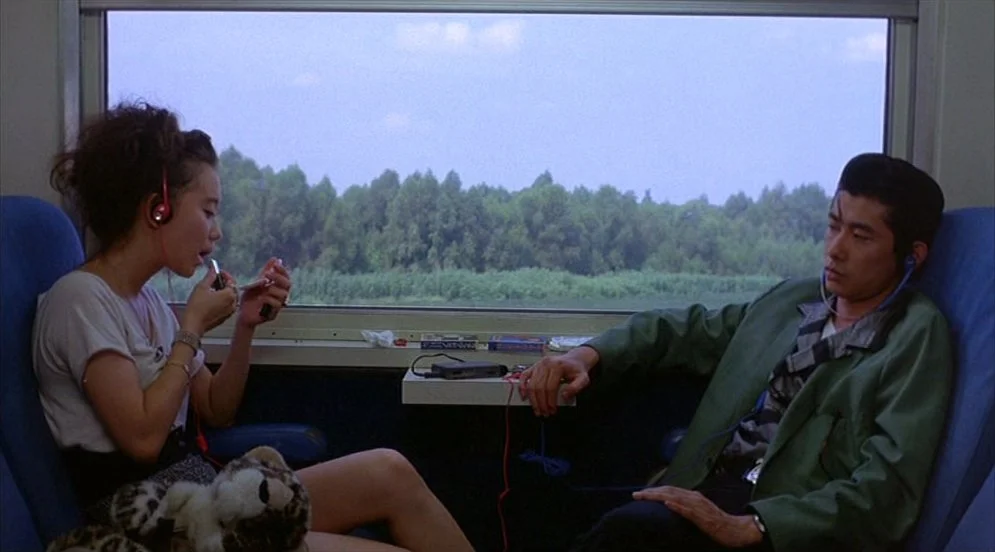
From its opening moments, Mystery Train announces this commitment to slowness. A young Japanese couple, Mitsuko and Jun, travel by train to Memphis on a rock n’ roll pilgrimage. They sit opposite one another in near silence, sharing a Walkman, swapping cassettes, and passing the time with games of rock-paper-scissors. Nothing much happens. In most contemporary films, these moments would be trimmed away in service of the story. Jarmusch, however, lingers. The journey itself becomes more important than the destination. Once the pair arrive in Memphis, Jun simply suggests that they "walk around", and the camera drifts alongside them as they wander through a landscape of boarded-up shop fronts and empty warehouses. Elvis is everywhere and nowhere; American culture survives as a collection of signs and souvenirs. Yet it is precisely through the film's slowness that these details become visible. A passing Cadillac, a shop sign, a glance exchanged between characters acquire greater significance.
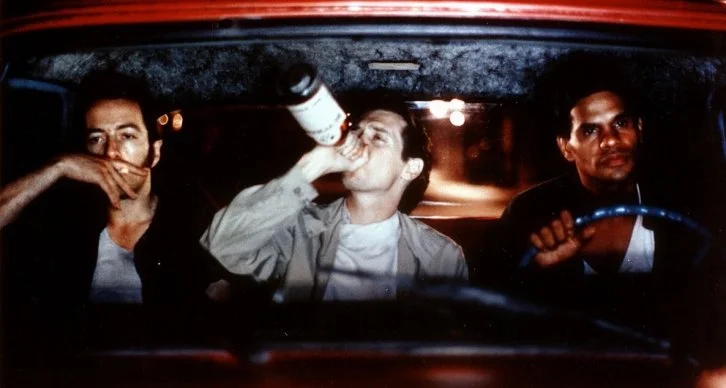
Mystery Train is a film that spends a lot of time depicting characters who are waiting, a condition that has become increasingly alien to contemporary life. Each of the three sections is predicated on the temporary liminality of characters checking into a motel for the night, waiting to leave the next day. Even when violence erupts in the film's final chapter, as Johnny (Joe Strummer of The Clash), his friend Will (Rick Aviles) and his brother-in-law (Steve Buscemi) are caught in a shooting, the characters do not race through the streets in a frantic escape sequence. Instead, they drive aimlessly through the night, drinking in silence - “forever, it seems”, as Roger Ebert noted in his 1989 review. They’re caught between action and consequence, suspended in shock and inertia rather than propelled toward meaning or resolution. While such sustained attention to waiting and banality risks producing boredom, Jarmusch instead mobilises this as a means of paying closer attention to the world and the people who inhabit it.
Jarmusch offers no clear markers of simultaneity between the film’s three sections; instead, he threads them together through repetition and repeated sounds. A gunshot recurs across all three narratives, while Tom Waits’ radio DJ drifts in and out, announcing Elvis’ Blue Moon at 2:17am just as each set of characters tunes in. Repeated scenes similarly punctuate the film, sometimes truncated, sometimes extended, of banal exchanges between the bellboy (Cinque Lee) and the night clerk (Screamin’ Jay Hawkins) at the motel. Each time they’re repeated, a different take of the scene is used, in which the minutiae of performance subtly diverge. There’s an uncanny impression that the ‘similar is not the same’; what feels familiar is simultaneously estranged, destabilising the audience’s confidence in a recoverable past. Instead, time in Mystery Train is continually reconstituted through the experience of the present moment. Against the logic of the attention economy, this instability encourages the audience to ‘slow down’ and attend to the micro-dramas of each moment.
In a culture that prioritises speed, efficiency and constant stimulation, Jarmusch presents us with a film dictated by slowness, where small moments are expanded. Boredom, generated through the film’s lingering depiction of liminal states, becomes not a failure of narrative drive but a condition through which time is no longer simply passed, but actively inhabited.